The most dangerous sentence in an AI-assisted proposal is often the one that sounds entirely normal. “Our team provides round-the-clock support” reads smoothly, but it is a problem if your evidence only covers business hours. Better wording cannot fix missing evidence.
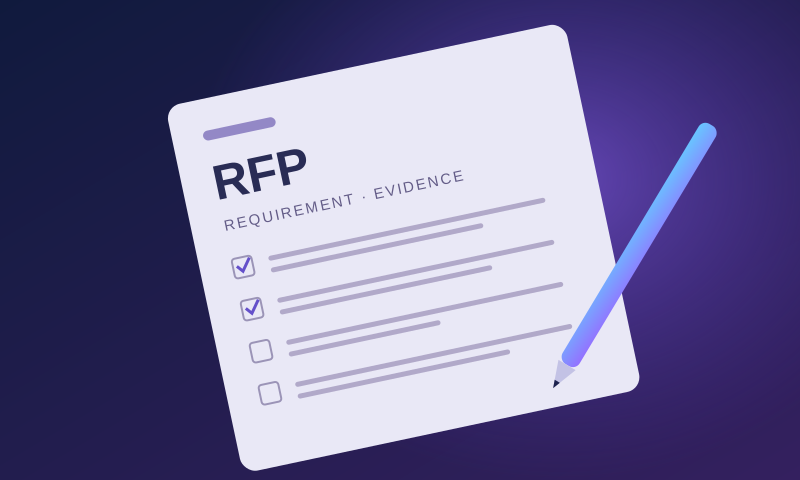
Before drafting, build a matrix that links each buyer requirement to a source and an owner. The example below is fictional. It shows a review method, not a claim about InriGPT or a customer’s certifications.
Separate the buyer’s request from your evidence
Keep two source sets: the buyer’s requirements, and the documents your team can use to support its response. A requirement is not proof that you meet it. If a tender asks for a certification, copying that request into the evidence folder does not make the certification yours.
Give each source a short identifier and a revision date. “Support handbook, version 3, section 4” is more useful than “company docs”. Where a document contains a customer name or confidential information, prepare an authorised excerpt instead of uploading the whole file to a public tool.
Use five columns that force a decision
| ID | Requirement | Evidence | Gap | Owner |
|---|---|---|---|---|
| R01 | Support available 24 hours a day | Handbook v3: weekdays, 09:00–17:00 | Out-of-hours coverage not supported | Operations lead |
| R02 | Named delivery manager | Draft staffing plan names a role, not a person | Appointment needs confirmation | Project lead |
| R03 | Monthly progress report | Reporting template v2 contains monthly sections | Confirm the proposed reporting owner | Account lead |
The gap column is the useful part. It turns a vague writing task into decisions your team must make. Do not treat the assistant’s confidence, or a document’s professional formatting, as a substitute for evidence.
Ask AI to extract before it writes
For each numbered requirement, list the relevant supplied source, the exact supporting passage and any contradiction or missing evidence. Do not infer compliance from a related capability. If the sources do not establish a claim, label it “not supported by the supplied material”. Do not write the final proposal yet.
Review this extraction against the original documents. Numbers, exceptions, dates and the difference between “may” and “will” deserve particular attention. A short source passage helps, but it can still be taken out of context; check the surrounding section when the meaning is important.
Resolve gaps with people who can approve the claim
For R01 above, the options might be to decline the requirement, propose a clearly stated exception, or agree an additional service with the operations lead. The assistant cannot decide that the company now offers overnight coverage. Record the approved answer and its evidence before moving to prose.
For R02, a placeholder such as “[delivery manager to be confirmed]” is an honest working-draft marker. It should not survive into a submitted response by accident. Give every unresolved marker an owner and a review deadline.
Draft one section at a time
When the matrix is approved, ask the assistant to write a section using only the accepted rows. Include the buyer’s requested structure and word limit. Tell it to retain explicit exceptions rather than smoothing them away.
A second review can compare the draft with the matrix. Search for promises, quantities, named people, certifications and deadlines. Every important claim should have an approved source. If a sentence is merely persuasive language, make sure it does not introduce a new commitment.
Keep a submission checklist outside the generated prose
- All mandatory questions have an answer or a consciously approved exception.
- Every factual claim can be traced to a current source.
- Commercial terms and delivery commitments have the right approval.
- No unresolved markers, comments or confidential source extracts remain.
- The final attachment format, file name and submission deadline match the buyer’s instructions.
These checks remain a human responsibility. Our captured AI draft review shows why unsupported claims need explicit treatment. You can try a sample in the workflow demo or explore the proposal and RFP service after deciding which review steps your team needs.