During a live InriGPT demo check on 22 November 2026, the page loaded and the request passed verification, but the AI result did not arrive. The interface returned a temporary-unavailability message. A basic service health check still reported an operational connection.
The problem was a retired model. This is a first-hand maintenance note about what we observed and changed. It is not a customer success story or a promise that service interruptions cannot happen.
What the live test showed
We loaded the demo’s supplied proposal sample and submitted it through the normal browser interface. This exercised more than a health endpoint: the page, verification, server request and model inference all had to work together to produce an answer.
The provider’s response identified the text model as retired. Cloudflare had scheduled the retirement of Qwen3 30B and the LLaVA image-understanding model for 20 November. Its published deprecation notice describes the affected models and error behaviour.
Both model identifiers were still present in our application configuration. That made this a configuration maintenance failure, even though the surrounding network and website were reachable.
Why the status check did not catch it
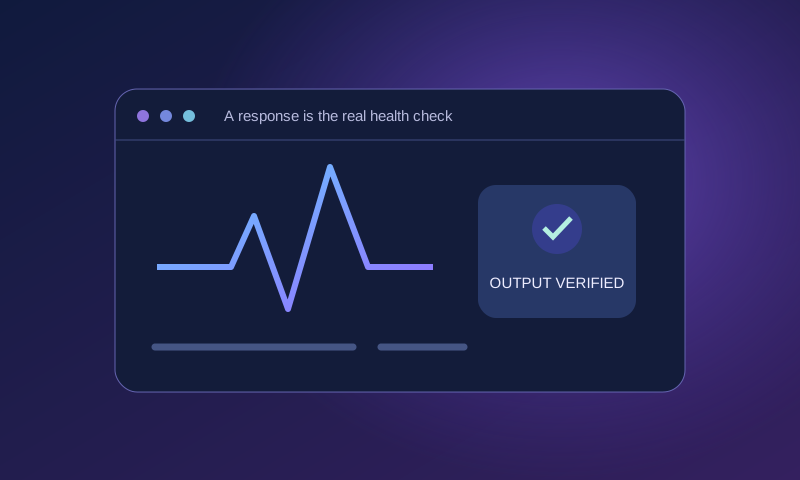
A connection check asks whether an endpoint can be reached and can answer a basic request. An inference test asks whether the configured model can actually return useful output. Passing the first does not establish the second.
This distinction matters for any AI-powered workflow. A green indicator should tell you what was tested. It should not imply that every model, document import, payment or user journey has just been exercised. InriGPT’s public status description distinguishes connection checks from actual inference.
What changed in this repair
We replaced the retired text model with Cloudflare’s supported Gemma 4 26B A4B model and added GLM 4.7 Flash as a bounded fallback for model-capacity or retirement errors. The fallback does not bypass authentication, application quotas or the provider’s daily allowance.
Image understanding also moved to Gemma 4. We adapted the request to its multimodal input format and checked it with a synthetic red image. The returned answer identified red as the dominant colour. That is a narrow functionality check, not a benchmark of complex visual reasoning.
The output adapter required attention too. The replacement model returned its final answer in an OpenAI-compatible choices structure, while the previous application expected a response field. We now normalise those supported formats and avoid displaying reasoning-only fields as the final answer.
What we verified
- Automated Worker tests covered supported answer formats, bounded fallback, authentication and usage controls.
- A direct text request returned a real response from the replacement provider model.
- The synthetic image test returned an appropriate colour description.
- The public browser demo produced a proposal review after deployment.
The proposal output separated supplied evidence from missing evidence. It marked a missing certification and an unverified staffing timeline instead of presenting them as established facts. That is the kind of behaviour a human reviewer still needs to inspect before using the draft.
These checks show that the repaired paths worked during verification. They do not establish continuous availability, an accuracy guarantee or an end-to-end test of every feature on the platform.
A practical check for your own AI workflow
Keep one small synthetic test case for each essential model capability. Define an expected property, such as “returns a non-empty answer” or “preserves the missing-evidence marker”, rather than relying on an exact sentence that a model may phrase differently.
Track the model identifiers in use and the provider’s retirement notices. When changing a model, test both its input contract and output shape. Check the actual user interface after deployment; an isolated API success does not prove that the browser can display the result.
Use test data rather than customer documents for this monitoring. Keep the test small, account for provider usage, and make sure failures reach the person responsible for maintenance.
You can try the repaired public demo or inspect the service-status page. Our older captured draft examples remain labelled with their original model and capture date so historical evidence is not confused with a new test.